" height="29px" id="bXox46a9X" width="107.99999713627835px"/></svg>)
Hundreds of Flows.
No Source of Truth.
I was the Lead Product Designer working alongside the Consumer Lifecycle platform team. As a contractor, I worked outside of the design org. On the project, I had full autonomy over design direction.
Hundreds of Flows.
No Source of Truth.
I was the Lead Product Designer working alongside the Consumer Lifecycle platform team. As a contractor, I worked outside of the design org. On the project, I had full autonomy over design direction.
Hundreds of Flows.
No Source of Truth.
I was the Lead Product Designer working alongside the Consumer Lifecycle platform team. As a contractor, I worked outside of the design org. On the project, I had full autonomy over design direction.
Hundreds of Flows.
No Source of Truth.
I was the Lead Product Designer working alongside the Consumer Lifecycle platform team. As a contractor, I worked outside of the design org. On the project, I had full autonomy over design direction.
The Problem
What is the Real Experience?
Teams at Netflix couldn't actually see what a customer saw. Yes, they had a designer's staging of a happy path, they had data science teams that could analyze the funnel, and they had engineers that could look at logs, but even with all that, it's simply hard to know what any given session actually looked like. On top of that, all the different combinations of devices, member states, languages, locales, active A/B tests, etc.
Legal could not verify a customer or government inquiry about an experience that might be years old.
Design could not scope a redesign without manually auditing what existed or if other flows would be impacted.
Localization could not translate confidently without context or if translated text broke the layout.
The Problem
What is the Real Experience?
Teams at Netflix couldn't actually see what a customer saw. Yes, they had a designer's staging of a happy path, they had data science teams that could analyze the funnel, and they had engineers that could look at logs, but even with all that, it's simply hard to know what any given session actually looked like. On top of that, all the different combinations of devices, member states, languages, locales, active A/B tests, etc.
Legal could not verify a customer or government inquiry about an experience that might be years old.
Design could not scope a redesign without manually auditing what existed or if other flows would be impacted.
Localization could not translate confidently without context or if translated text broke the layout.
The Problem
What is the Real Experience?
Teams at Netflix couldn't actually see what a customer saw. Yes, they had a designer's staging of a happy path, they had data science teams that could analyze the funnel, and they had engineers that could look at logs, but even with all that, it's simply hard to know what any given session actually looked like. On top of that, all the different combinations of devices, member states, languages, locales, active A/B tests, etc.
Legal could not verify a customer or government inquiry about an experience that might be years old.
Design could not scope a redesign without manually auditing what existed or if other flows would be impacted.
Localization could not translate confidently without context or if translated text broke the layout.
The Problem
What is the Real Experience?
Teams at Netflix couldn't actually see what a customer saw. Yes, they had a designer's staging of a happy path, they had data science teams that could analyze the funnel, and they had engineers that could look at logs, but even with all that, it's simply hard to know what any given session actually looked like. On top of that, all the different combinations of devices, member states, languages, locales, active A/B tests, etc.
Legal could not verify a customer or government inquiry about an experience that might be years old.
Design could not scope a redesign without manually auditing what existed or if other flows would be impacted.
Localization could not translate confidently without context or if translated text broke the layout.

The Process
Gathering Team Assumptions
When I jumped in, the team had already done lots of work standing up the back-end architecture, as well as speaking to different teams about their specific use cases. I needed to get all that info out of their brains. So I ran a FigJam workshop. I prompted them with questions about user pain points, current solutions, workarounds, and end-to-end journeys. Of course, some of the answers were assumptions. But this gave me a basis for strong research questions. That is, what should I know in order to make evidence-based decisions?
The Process
Gathering Team Assumptions
When I jumped in, the team had already done lots of work standing up the back-end architecture, as well as speaking to different teams about their specific use cases. I needed to get all that info out of their brains. So I ran a FigJam workshop. I prompted them with questions about user pain points, current solutions, workarounds, and end-to-end journeys. Of course, some of the answers were assumptions. But this gave me a basis for strong research questions. That is, what should I know in order to make evidence-based decisions?
uncovering conflict
Flows are Understood Differently

To a Designer
A flow is the path you intend: a linear sequence from entry point to success state. Clear start, clear end, clear purpose. The happy path.

To an Engineer
A flow is a graph traversal. Nodes connected by conditional logic, no fixed start or end. The path depends entirely on the user's state.

To a Customer
A flow is whatever actually happened: errors, back-navigation, dead ends. Two users starting from the same screen may never share a path.
uncovering conflict
Flows are Understood Differently
To a Designer
A flow is the path you intend: a linear sequence from entry point to success state. Clear start, clear end, clear purpose. The happy path.
To an Engineer
A flow is a graph traversal. Nodes connected by conditional logic, no fixed start or end. The path depends entirely on the user's state.
To a Customer
A flow is whatever actually happened: errors, back-navigation, dead ends. Two users starting from the same screen may never share a path.
uncovering conflict
Flows are Understood Differently
To a Designer
A flow is the path you intend: a linear sequence from entry point to success state. Clear start, clear end, clear purpose. The happy path.
To an Engineer
A flow is a graph traversal. Nodes connected by conditional logic, no fixed start or end. The path depends entirely on the user's state.
To a Customer
A flow is whatever actually happened: errors, back-navigation, dead ends. Two users starting from the same screen may never share a path.
To a Designer
A flow is the path you intend: a linear sequence from entry point to success state. Clear start, clear end, clear purpose. The happy path.
To an Engineer
A flow is a graph traversal. Nodes connected by conditional logic, no fixed start or end. The path depends entirely on the user's state.
To a Customer
A flow is whatever actually happened: errors, back-navigation, dead ends. Two users starting from the same screen may never share a path.
design decision
Product Teams Define Their Flows
As mentioned, the back-end had nodes. A node is simply a spot where a user lands. That node could have different screens associated with it (that is, what the customer is actually seeing). So if a team wanted to find a particular flow, say sign-up, it would first need to be defined: the sign-up flow equals these nodes, edges, and screens. Our team decided we shouldn't be responsible for flow definitions. Flows were seeded in the system with the help of designers since they knew their domains best. We also added a Flow Builder feature to enable teams to create themselves.

design decision
Product Teams Define Their Flows
As mentioned, the back-end had nodes. A node is simply a spot where a user lands. That node could have different screens associated with it (that is, what the customer is actually seeing). So if a team wanted to find a particular flow, say sign-up, it would first need to be defined: the sign-up flow equals these nodes, edges, and screens. Our team decided we shouldn't be responsible for flow definitions. Flows were seeded in the system with the help of designers since they knew their domains best. We also added a Flow Builder feature to enable teams to create themselves.
design decision
Product Teams Define Their Flows
As mentioned, the back-end had nodes. A node is simply a spot where a user lands. That node could have different screens associated with it (that is, what the customer is actually seeing). So if a team wanted to find a particular flow, say sign-up, it would first need to be defined: the sign-up flow equals these nodes, edges, and screens. Our team decided we shouldn't be responsible for flow definitions. Flows were seeded in the system with the help of designers since they knew their domains best. We also added a Flow Builder feature to enable teams to create themselves.
design decision
Product Teams Define Their Flows
As mentioned, the back-end had nodes. A node is simply a spot where a user lands. That node could have different screens associated with it (that is, what the customer is actually seeing). So if a team wanted to find a particular flow, say sign-up, it would first need to be defined: the sign-up flow equals these nodes, edges, and screens. Our team decided we shouldn't be responsible for flow definitions. Flows were seeded in the system with the help of designers since they knew their domains best. We also added a Flow Builder feature to enable teams to create themselves.
The value proposition
Finding the Right Flow
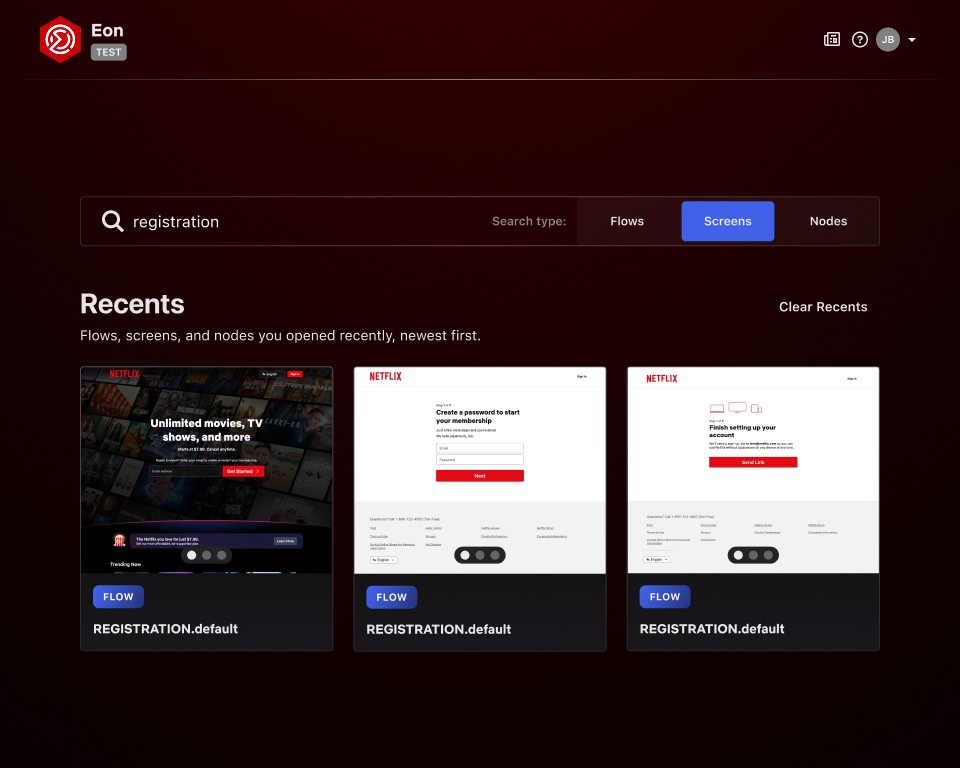
Use case: A designer is tasked with improving the registration flow. First, they might ask: if I touch screen X, what other flows are impacted? Any active A/B tests? Is there a variation in country Z? Another: Legal gets a claim that a customer did not receive a promotion. They say the promotion promised 3 months of free Netflix. This was a year ago. So what did the promotion actually say? And many, many more. This is what Eon would deliver. Searching for flows exactly as the customer would have seen them. Shipped!
The value proposition
Finding the Right Flow
Use case: A designer is tasked with improving the registration flow. First, they might ask: if I touch screen X, what other flows are impacted? Any active A/B tests? Is there a variation in country Z? Another: Legal gets a claim that a customer did not receive a promotion. They say the promotion promised 3 months of free Netflix. This was a year ago. So what did the promotion actually say? And many, many more. This is what Eon would deliver. Searching for flows exactly as the customer would have seen them. Shipped!
The value proposition
Finding the Right Flow
Use case: A designer is tasked with improving the registration flow. First, they might ask: if I touch screen X, what other flows are impacted? Any active A/B tests? Is there a variation in country Z? Another: Legal gets a claim that a customer did not receive a promotion. They say the promotion promised 3 months of free Netflix. This was a year ago. So what did the promotion actually say? And many, many more. This is what Eon would deliver. Searching for flows exactly as the customer would have seen them. Shipped!
The value proposition
Finding the Right Flow
Use case: A designer is tasked with improving the registration flow. First, they might ask: if I touch screen X, what other flows are impacted? Any active A/B tests? Is there a variation in country Z? Another: Legal gets a claim that a customer did not receive a promotion. They say the promotion promised 3 months of free Netflix. This was a year ago. So what did the promotion actually say? And many, many more. This is what Eon would deliver. Searching for flows exactly as the customer would have seen them. Shipped!
Testing & Contraints
Using AI in the codebase let me test on real data, surfacing two discoveries. First: flow metadata at the top (country, language, etc) was confusing, users expecting it to act like a dropdown. I moved it to the bottom so it read properly as a reference. Second: I'd designed search as one query across all entities. The backend had no cross-entity filters. I decided to put an entity selector as a required choice next to the search field.
Key Screens Delivered

Landing Screen

Search Results

Flow Builder

Creating a Flow

Screen Details

Key String Search
Key Screens Delivered
Landing Screen
Search Results
Flow Builder
Creating a Flow
Screen Details
Key String Search
Key Screens Delivered
Landing Screen
Search Results
Flow Builder
Creating a Flow
Screen Details
Key String Search
Key Screens Delivered
Landing Screen
Search Results
Flow Builder
Creating a Flow
Screen Details
Key String Search
Future State Delivery
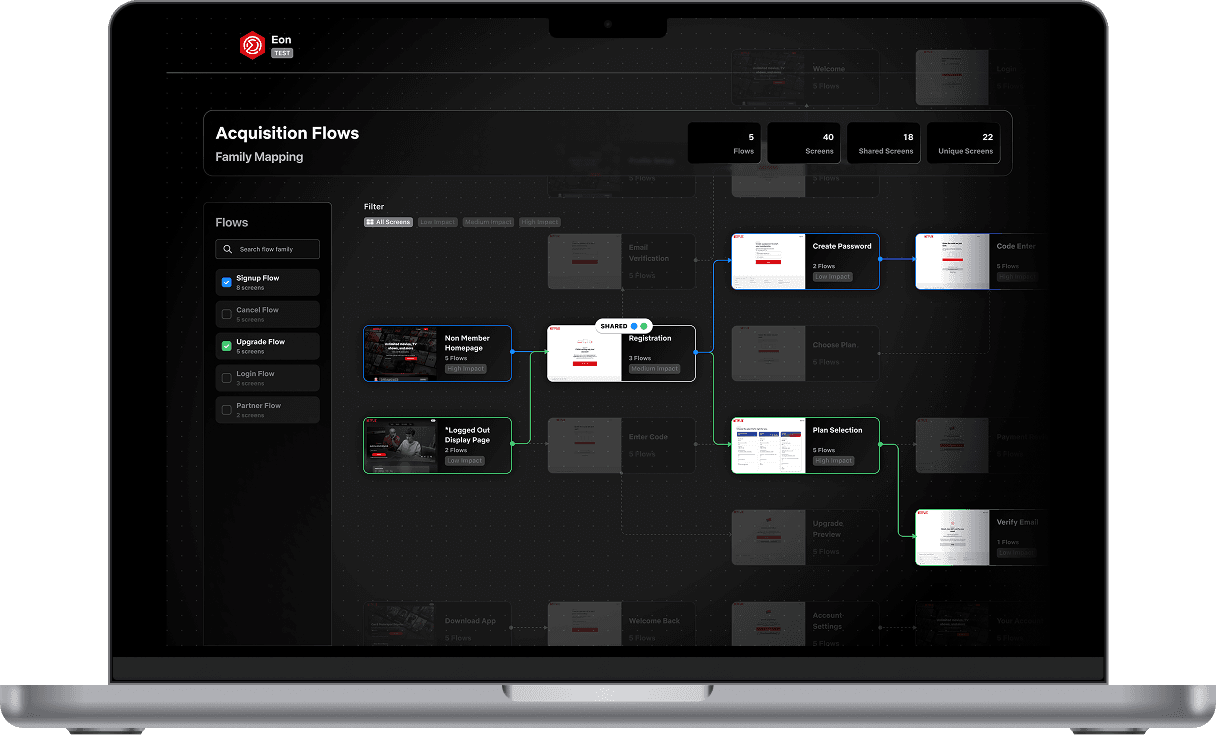
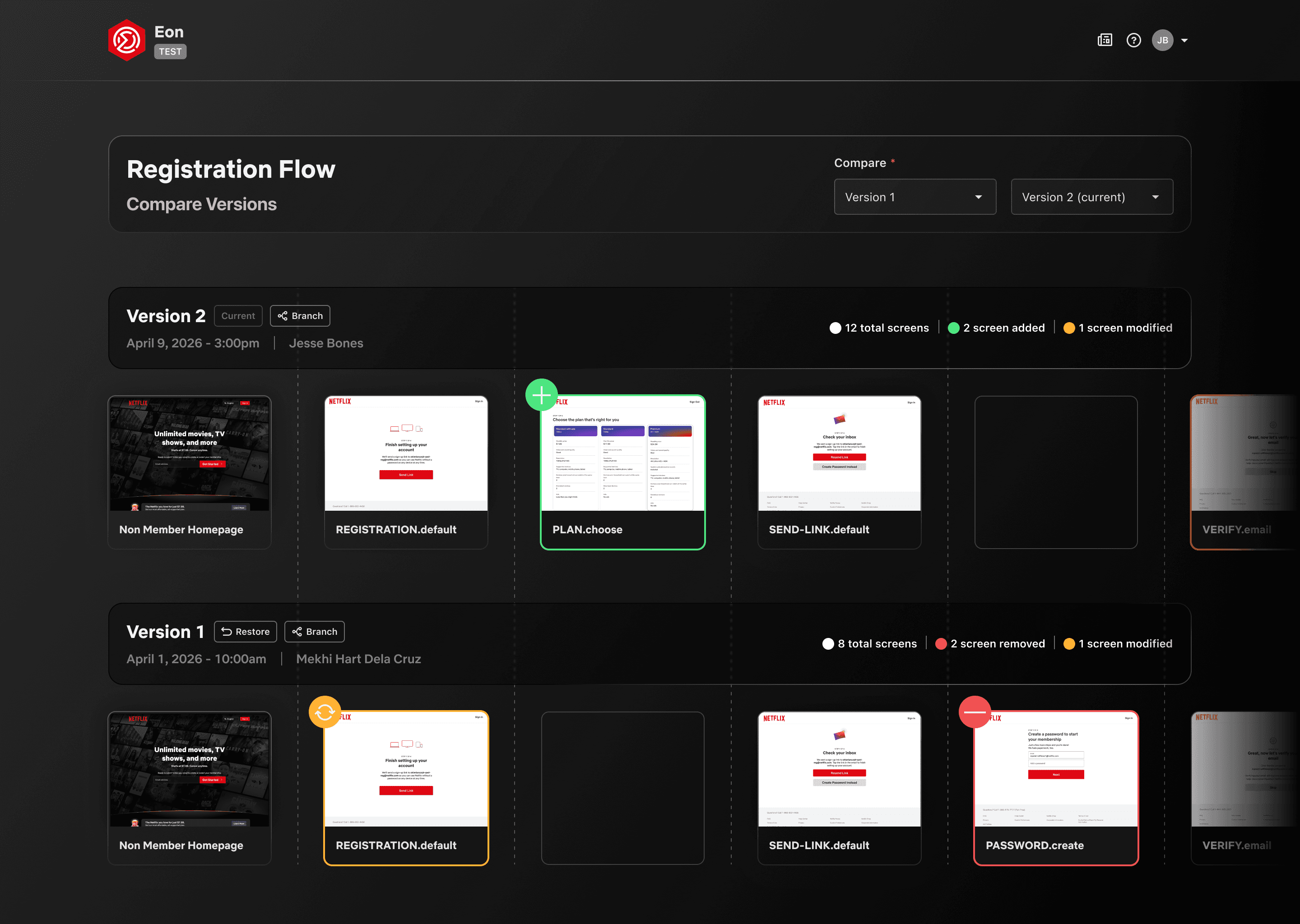
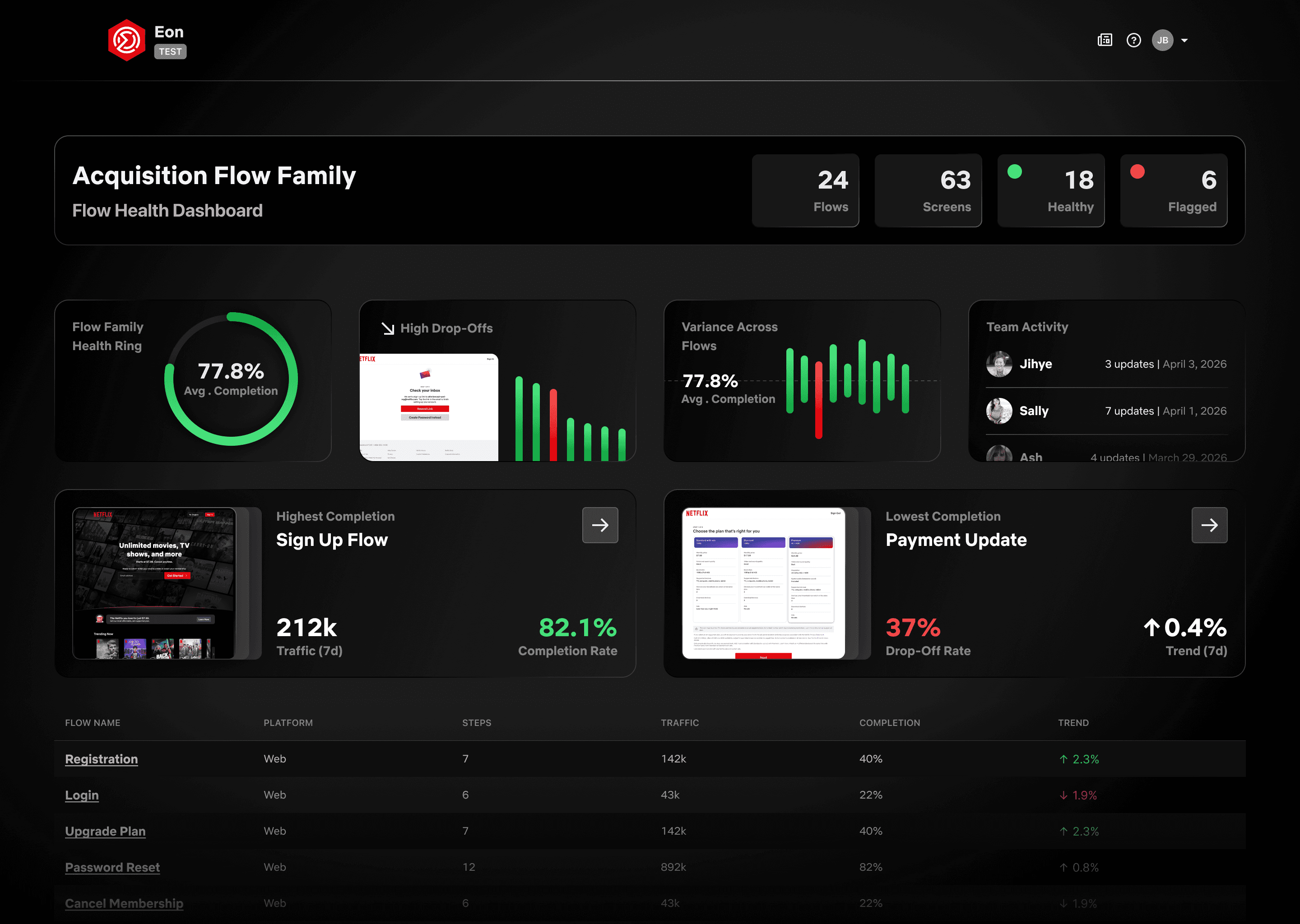
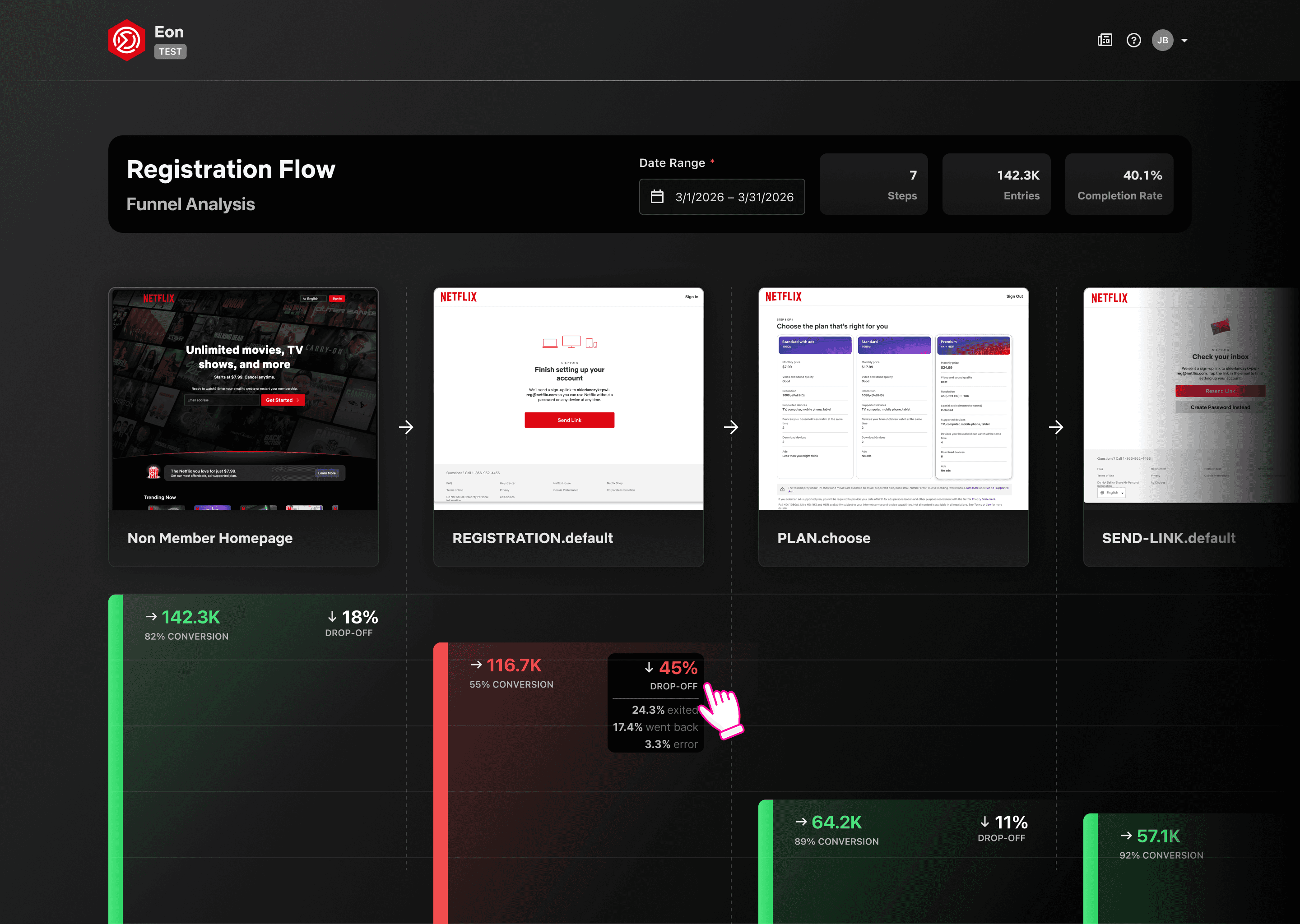
Before leaving Netflix, I designed four concept explorations as a north star for the team — showing how Eon could evolve from documentation to intelligence: flow health, dependency mapping, funnel analytics, and no-code copy editing.
Future State Delivery
Before leaving Netflix, I designed four concept explorations as a north star for the team — showing how Eon could evolve from documentation to intelligence: flow health, dependency mapping, funnel analytics, and no-code copy editing.
Future State Delivery
Before leaving Netflix, I designed four concept explorations as a north star for the team — showing how Eon could evolve from documentation to intelligence: flow health, dependency mapping, funnel analytics, and no-code copy editing.
Future State Delivery
Before leaving Netflix, I designed four concept explorations as a north star for the team — showing how Eon could evolve from documentation to intelligence: flow health, dependency mapping, funnel analytics, and no-code copy editing.
Copyright © 2025 Jesse Bones. All Rights Reserved. All content, designs, and images on this website are the property of Jesse Bones and respective clients. Unauthorized use, reproduction, or distribution of any materials without explicit permission is prohibited.
Copyright © 2025 Jesse Bones. All Rights Reserved. All content, designs, and images on this website are the property of Jesse Bones and respective clients. Unauthorized use, reproduction, or distribution of any materials without explicit permission is prohibited.
Copyright © 2025 Jesse Bones. All Rights Reserved. All content, designs, and images on this website are the property of Jesse Bones and respective clients. Unauthorized use, reproduction, or distribution of any materials without explicit permission is prohibited.
Copyright © 2025 Jesse Bones. All Rights Reserved. All content, designs, and images on this website are the property of Jesse Bones and respective clients. Unauthorized use, reproduction, or distribution of any materials without explicit permission is prohibited.